

Outline
-
Introduction: Why Choosing the Right Backpack Matters More Than You Think
-
The Four Core Factors: Ergonomics > Empty Weight > Size > Looks
-
Buying Guide by Scenario
-
Elementary School Backpacks: Spine Support and Lightweight Design Come First
-
Middle and High School Backpacks: Large Capacity and Back Support Matter Equally
-
College Backpacks: Function Meets Style
-
-
Materials and Workmanship: The Details That Decide How Long a Backpack Lasts
-
Use and Care: Buying the Right One Is Only Step One
-
People Also Ask: Student Backpack FAQ
1. Introduction: Why Choosing the Right Backpack Matters More Than You Think
Disclosure: This article contains affiliate links. If you purchase through these links, we may earn a small commission at no extra cost to you. This does not affect our editorial judgment.
Back-to-school season rolls around, and the first thing parents start debating is “which backpack should we buy?” Store shelves are packed with options from budget-friendly to luxury, and the labels are endless: ergonomic, lightweight, suspension-reduced, posture-supporting. It is easy to feel overwhelmed.
But some recent data is worth paying attention to. According to the 2025 China Youth Spinal Health Blue Book published by the China Youth Development Foundation, about 71% of elementary school students carry backpacks that are too heavy, and 23% carry more than 15% of their body weight. A 2023 study conducted by researchers at the Shanghai Institute of Sports Science, surveying 2,000 elementary school students, reported that children who carried more than 15% of their body weight daily were more likely to experience shoulder and neck discomfort after one year, and showed a higher rate of abnormal spinal posture compared with children carrying lighter loads.
A poorly fitted backpack can do more than cause shoulder discomfort. It may affect a growing spine. This guide walks you through the buying logic, age-specific recommendations, and care tips you need to choose a suitable school backpack for your student.
2. The Four Core Factors: Ergonomics > Empty Weight > Size > Looks
Many parents choose a backpack based on looks first. The recommended priority is: ergonomic design > empty weight > size > appearance.
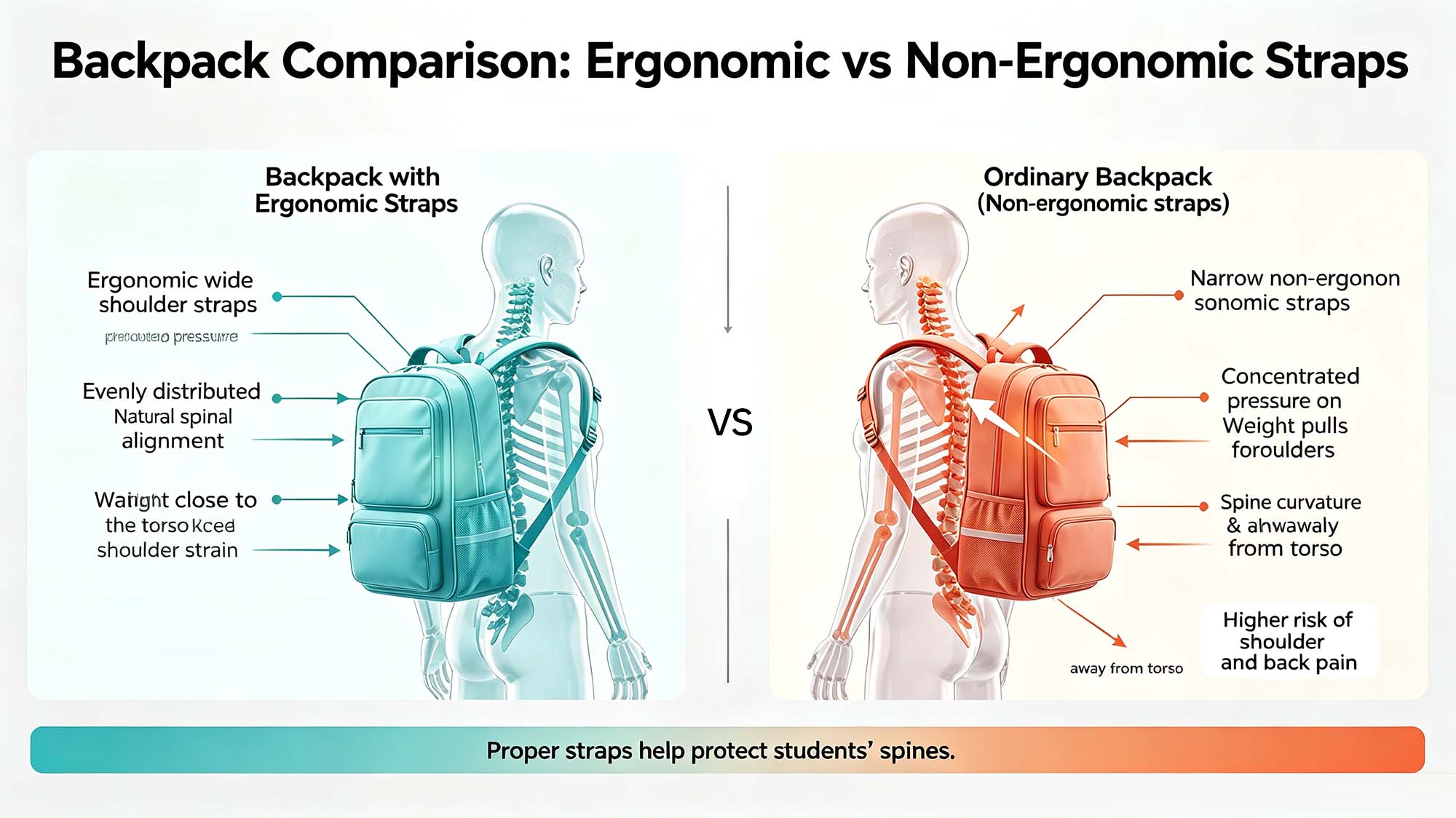
2.1 Ergonomics: Look at Structure, Not Marketing
Dr. Xu Shuai, deputy chief physician of spine surgery at Peking University People’s Hospital, has noted that ergonomic backpacks use biomechanical design and may help maintain the spine’s natural curve to some degree. However, their effect is limited. They should not be treated as a substitute for proper load management.
A genuinely effective ergonomically designed backpack system typically includes:
- Wide shoulder straps: at least 40 mm wide, with soft padding, to spread pressure across the shoulders. Straps that are too narrow concentrate pressure on the collarbone and trapezius, which may contribute to localized soreness.
- Sternum strap and hip belt: these keep the backpack stable, prevent shifting, and transfer some weight from the shoulders to the hips and waist.
- Rigid back panel: an S-shaped or X-shaped support structure that follows the spinal curve and avoids localized pressure.
- Close-to-back center of gravity: the backpack should sit close to the back, with heavier items positioned near the body so they do not pull the shoulders down.
Dr. Zeng Wen, deputy chief physician at Xi’an Honghui Hospital Spine Hospital, has advised that the backpack’s contact area should not exceed three-quarters of the child’s back. The bottom of the backpack should sit around the waist and should not sag below the buttocks.
2.2 Empty Weight: The Lighter, the Better
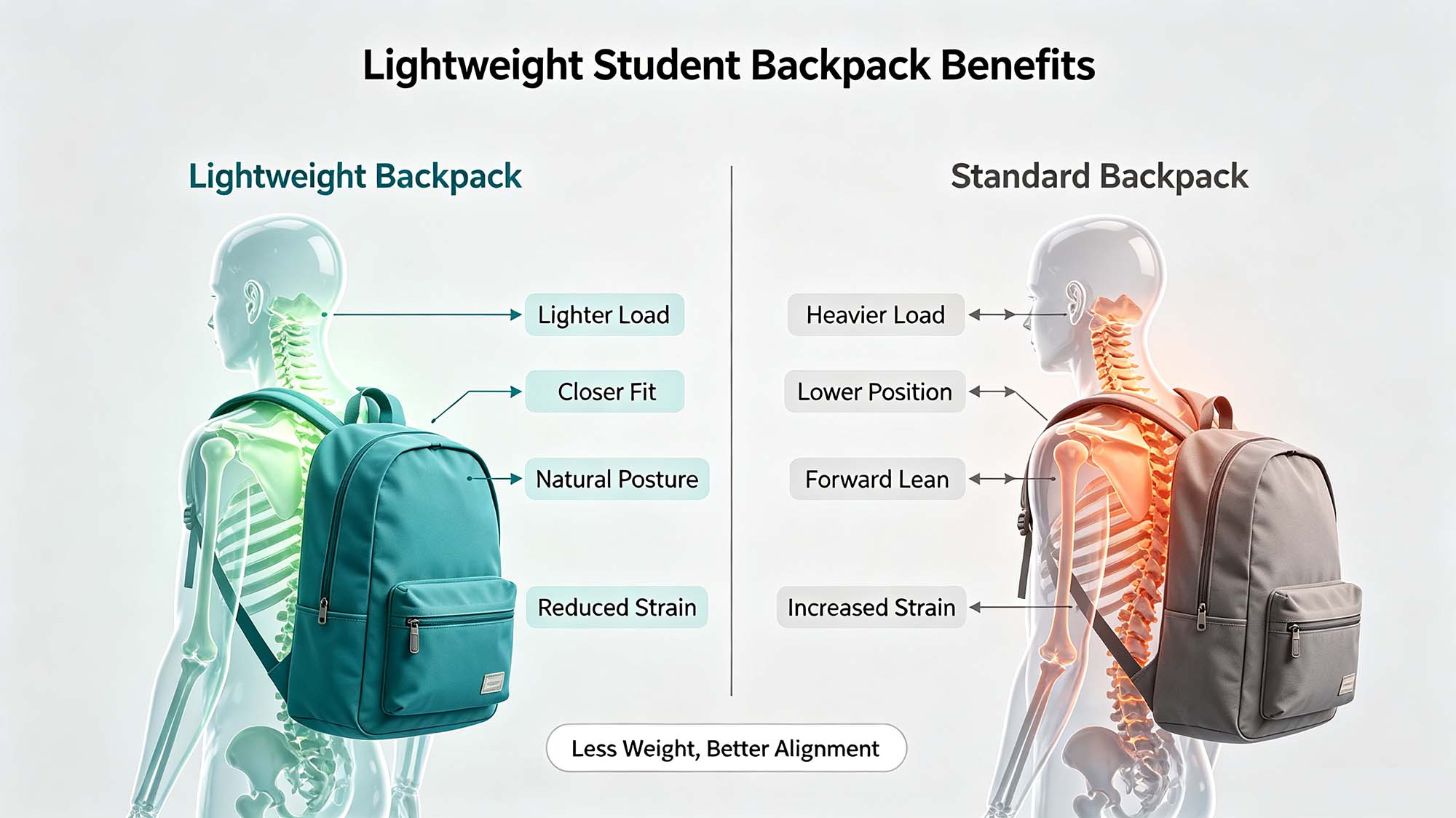
An empty backpack should weigh between 0.5 kg and 1.0 kg. Check the product’s stated weight before buying. When you pick it up empty, it should feel light.
2.3 Size: Choose by Height, Not Grade
Backpack size should match the child’s height rather than school grade. A simple rule: the backpack should not be wider than the shoulders, and the bottom should sit no more than about 10 cm below the waist. Have your child try it on. Make sure the lower edge does not go past the tailbone. If the backpack is too large, it may swing against the buttocks while walking and affect gait.
2.4 Looks: Consider It Last
Looking good matters, but it is the finishing touch. Once ergonomics, weight, and size all pass the test, let your child pick the color and style they like.

3. Buying Guide by Scenario
Elementary School Backpacks: Spine Support and Lightweight Design Come First
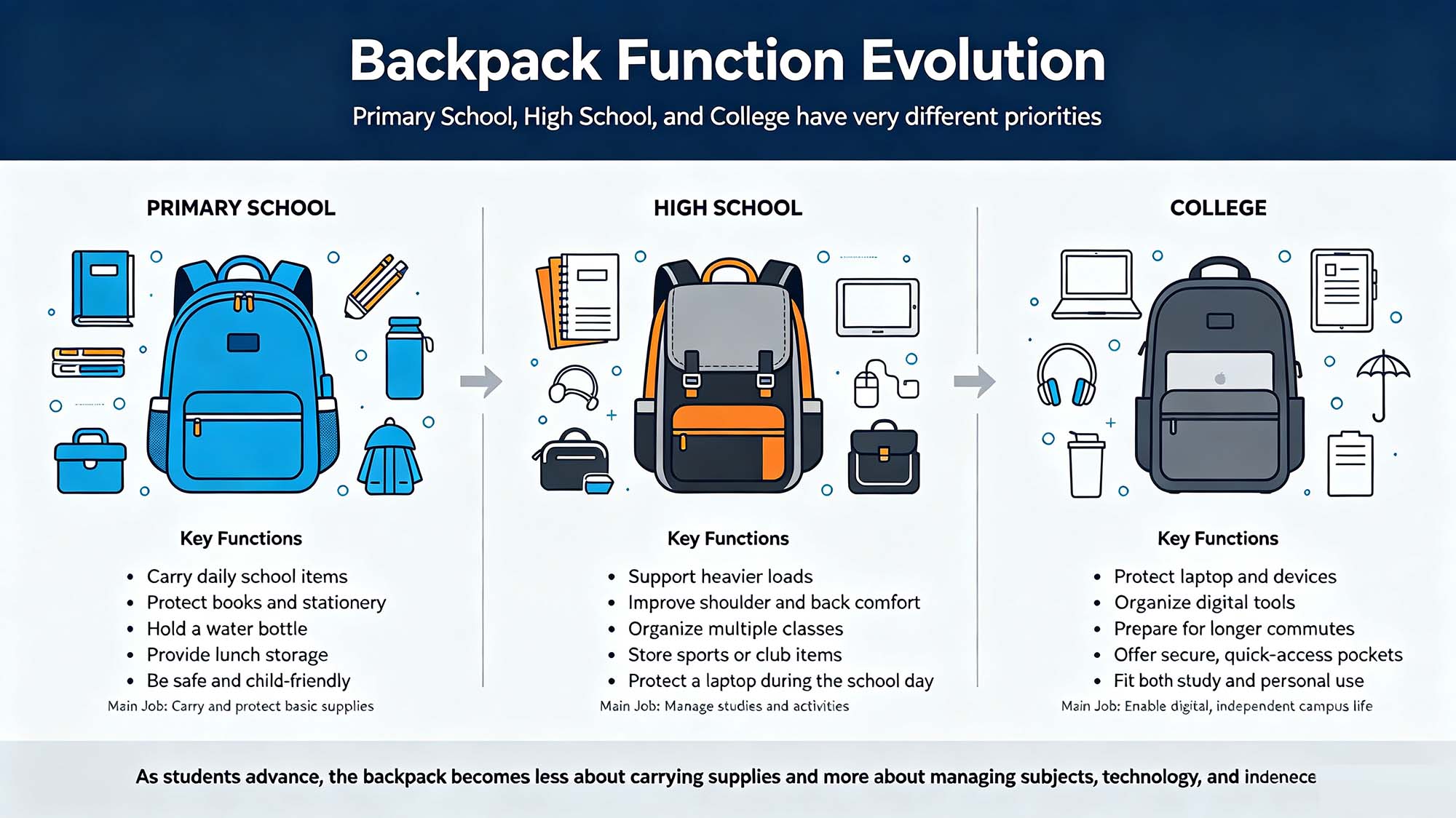
Elementary school students are in a critical period of spinal development, so backpack choice deserves extra attention.
Core indicators:
- Empty weight of 0.5–1.0 kg; total weight should not exceed 10% of the child’s body weight. For a 20 kg child, the backpack plus books should weigh no more than 2 kg.
- Shoulder straps at least 40 mm wide, with padding.
- Reflective strips are a must for safety when crossing the street.
- Choose a double-shoulder backpack. Single-shoulder bags may cause uneven spinal loading, and rolling backpacks are inconvenient on stairs and can be a tripping hazard.
Price reference:
According to orthopedic specialists, a basic ergonomic backpack in the $20–35** range is generally sufficient for daily use. Paying an extra **$10–20 for better materials or design is reasonable. Expensive ergonomic backpacks costing several hundred dollars or more do not necessarily show significantly better spine support compared with a well-made budget option. Most ergonomic school backpacks currently sell in the $25–45 range, so focus your search there.
Note: Children’s backpacks sold in the United States for children 12 and under are subject to CPSC regulations under CPSIA. Products must be tested by a CPSC-accepted third-party laboratory, and a Children’s Product Certificate (CPC) must be issued. If you are purchasing from a retailer, check that the product listing references compliance. If you are a seller, ensure your products meet these requirements before listing.
Middle and High School Backpacks: Large Capacity and Back Support Matter Equally
Once students enter middle and high school, textbooks, workbooks, test papers, pencil cases, water bottles, and more start piling up fast. Based on common load patterns observed in educational settings, middle school students typically carry about 28–35 liters of items per day. The ideal capacity range is 30–40 liters. Anything below 25 liters may cause books to stick out and zippers to strain.
Core indicators:
-
Capacity of 30–40 L, ideally with a laptop sleeve.
-
Empty weight around 1 kg to avoid a “big and heavy” backpack.
-
A rigid back panel, such as an S-shaped aluminum stay, to transfer weight effectively.
-
Clear internal compartments so books, stationery, and water bottles each have a place.
College Backpacks: Function Meets Style
College students have more freedom in choosing a backpack, but “comfortable to wear” and “big enough to carry everything” are still non-negotiable.
Core indicators:
-
15–25 L is enough for daily classes, holding a laptop, water bottle, documents, and personal items.
-
A laptop sleeve is essential: choose a model with an independent laptop compartment. The bottom of the sleeve should sit 2–3 cm above the bottom of the backpack, using an air layer for shock absorption so the laptop is not directly exposed to impact.
-
Shoulder straps should be 6–8 cm wide for better pressure distribution when carrying heavier loads.
-
Abrasion-resistant and water-resistant fabric to handle sudden rain. If you commute on public transit, an anti-theft laptop backpack with hidden zippers is a smart bonus.
4. Materials and Workmanship: The Details That Decide How Long a Backpack Lasts
Material choices:
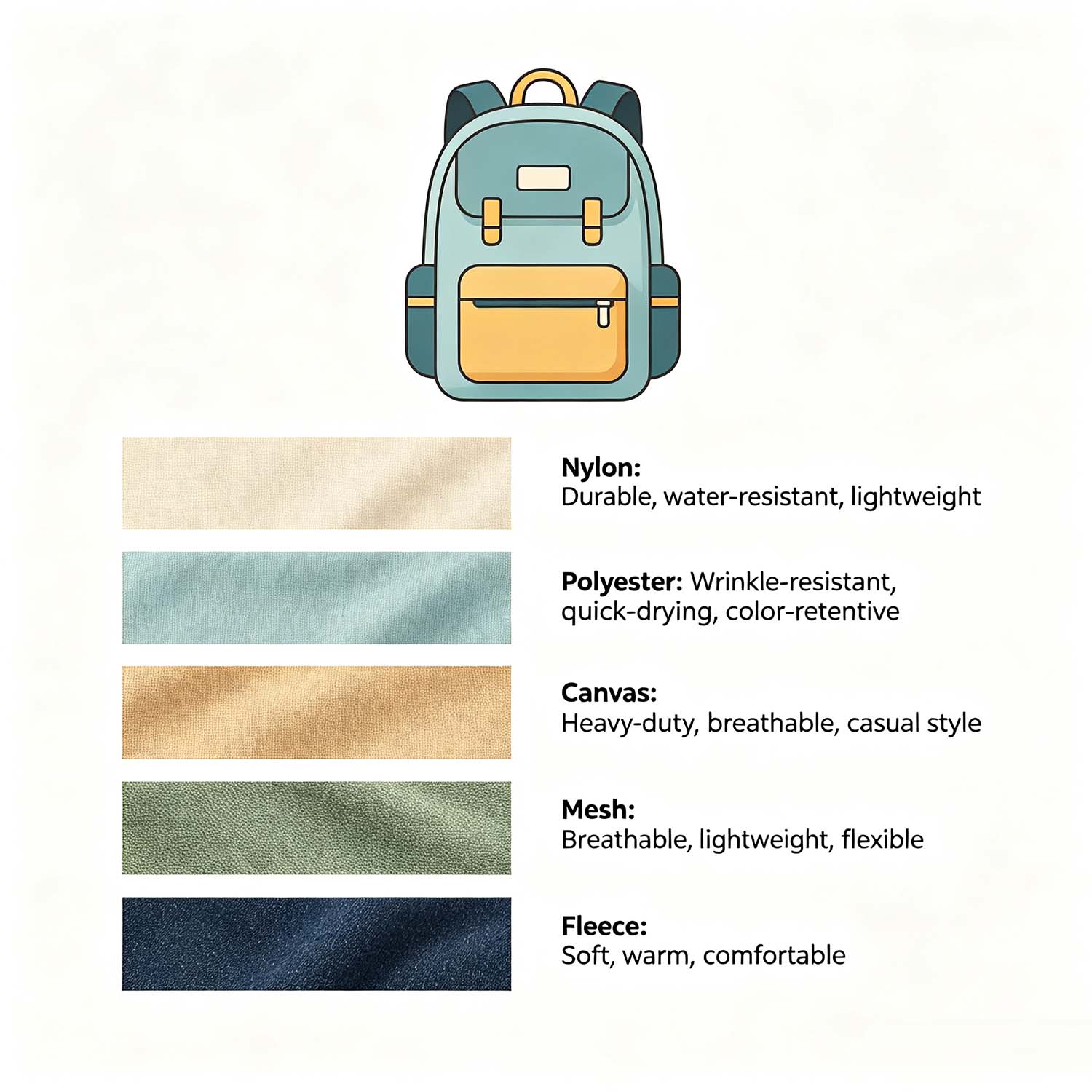
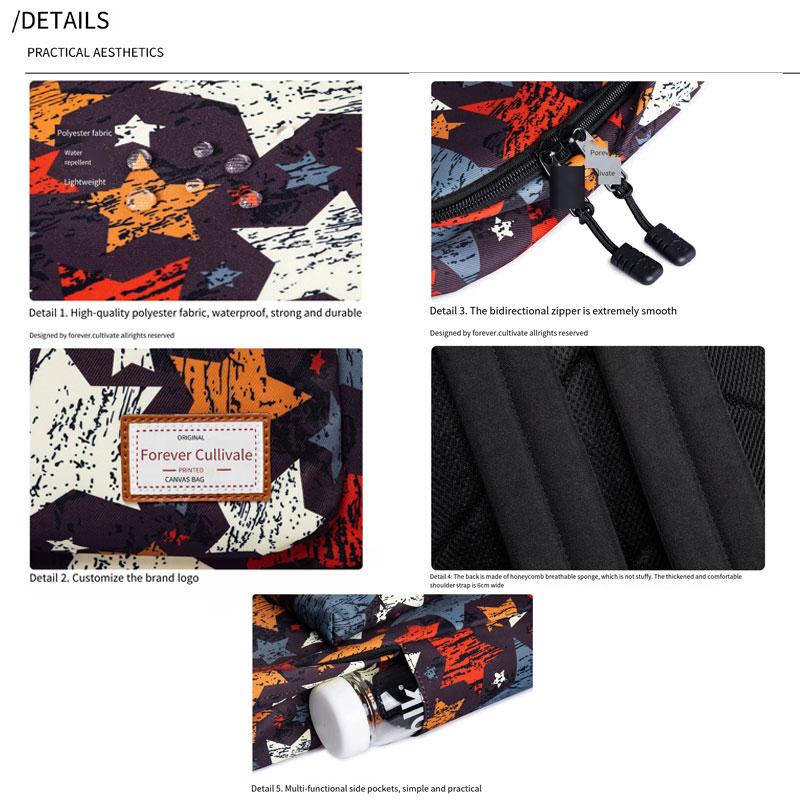
Prioritize polyester or nylon fabric. They are lightweight, durable, and easy to clean. Avoid backpacks with large amounts of plastic fittings, which can increase the risk of phthalate levels exceeding safety limits. The bottom should ideally have protective feet or studs; otherwise, it may wear through in a single semester.
Safety details:
-
Look for complete labeling and standards . Avoid “three-no” products with no brand, no manufacturer, and no quality certificate.
-
Choose products with low odor and minimal printed graphics. A strong chemical smell may indicate excessive formaldehyde or benzene compounds. Too much printing ink may contain lead, cadmium, and other heavy metals.
-
Check that stitching is tight and even, and that zippers run smoothly without misalignment.
5. Use and Care: Buying the Right One Is Only Step One
Choosing the right backpack is important, but daily habits matter just as much:
-
Declutter regularly: clean out unnecessary items every day to reduce weight at the source. Orthopedic experts stress that the real key to load reduction is carrying less, not relying on the backpack’s structure alone.
-
Wear it correctly: use both shoulders, fasten the sternum strap and hip belt, and keep the backpack close to the back. Do not sling it over one shoulder.
-
Build good posture habits: when reading and writing, keep eyes about one foot from the book, chest one fist from the desk, and fingers about one inch from the pen tip. Encourage students to stand up and move between classes.
-
Clean and store properly: fabric can usually be wiped with a damp cloth. Avoid machine washing, which can damage the back panel structure. Store in a dry, ventilated place.
6. People Also Ask: Student Backpack FAQ
Q: Are ergonomic backpacks a scam?
Not entirely. An effective ergonomic design — wide shoulder straps, sternum strap, hip belt, and a rigid back panel — may help spread pressure and reduce shifting, potentially offering some support for the spine. But its effect is limited. It cannot replace reducing weight and building good posture habits. A basic $20–35 backpack with sound structure can already provide fundamental ergonomic support.
Q: Are rolling backpacks worth buying?
Rolling backpacks take the weight off the body, which in theory reduces spinal load. But they are inconvenient on stairs and can trip the child when pulled. A consumer notice from an autonomous region market supervision bureau explicitly recommends avoiding rolling backpacks.
Q: How often should I replace a backpack?
There is no fixed schedule. But it is time for a new one if you notice these signs: shoulder straps visibly deformed, back panel support collapsed, zippers jamming frequently, bottom worn through, or the child leaning forward noticeably or complaining of shoulder pain.
Final Thoughts
You do not need the most expensive backpack. But do not compromise on three hard requirements: ergonomic structure, controlled empty weight, and proper size. For elementary school students, prioritize spine support and lightweight design. For middle and high school students, focus on large capacity and a strong support system. For college students, look for laptop protection and everyday practicality. After buying the right backpack, help your child build habits like organizing it daily and wearing it correctly. That is what truly puts “spine care” into practice.
Remember the simple rule: check the design, keep it light, and have the child try it on. A backpack is the learning companion your student uses every day. It is worth choosing with care.
I hope you can find the student backpack you're looking for. See you next time :)